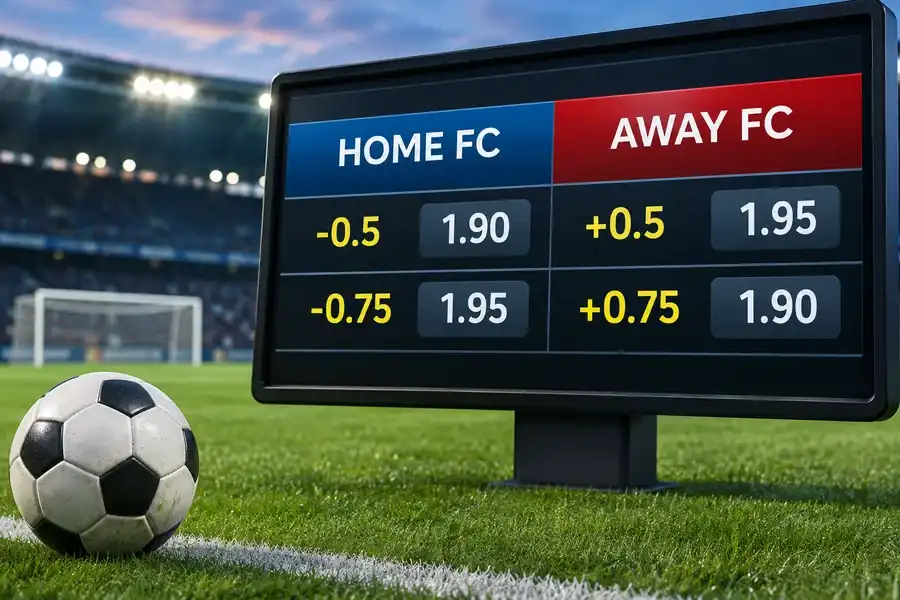
Asian handicap markets can look confusing at first, but the logic is simple once you understand the line. This beginner guide explains the rules, examples and calculations without promising outcomes.
Asian handicap betting explained in plain English
Asian handicap betting is a football market that gives one team a virtual head start and asks whether your chosen side can beat that adjusted line. Instead of choosing home win, draw or away win, you are backing a team after a handicap has been applied.
The handicap can be positive or negative. A negative line means the team starts behind on the betting line, so it must win by enough goals. A positive line means the team starts ahead on the betting line, so it can sometimes lose the real match and still settle as a win, push or half-loss on the bet.
The main attraction is that the draw can be removed or softened. On some lines, a draw on the handicap returns your stake. On others, the bet is split into two parts, so you can have a half-win or half-loss. That is why this market is popular in Football Handicap Tips and Asian Handicap Tips: it gives more precise ways to express an opinion than a simple match result.
Settlement rules are usually based on the official result for the stated market. For standard match Asian handicap, that normally means regular time plus stoppage time, not extra time or penalties, unless the market clearly says otherwise. Rules for abandoned, postponed or shortened matches can vary, so the market terms matter.
A useful way to think about it is this: add the handicap to the goals of the team you selected. If the adjusted score is higher than the opponent’s score, the bet wins. If it is equal, the stake is returned. If it is lower, the bet loses. Quarter lines use the same idea, but they split the stake across two nearby handicap lines.
Whole, half and quarter handicap lines
Asian handicap lines come in three common forms: whole goal, half goal and quarter goal. Each works slightly differently, so understanding the line is more important than memorising a long list of outcomes.
Whole goal handicaps
Whole goal lines are numbers such as 0, -1, +1, -2 or +2. Because the handicap is a whole number, a push is possible. A push means the bet is void on that line and your stake is returned.
The 0 line is often called level ball or draw no bet. If you back Team A on 0 and Team A wins, the bet wins. If the match is drawn, the stake is returned. If Team A loses, the bet loses.
A -1 line means your team must win by more than one goal for the bet to win. If it wins by exactly one goal, the handicap creates a draw and the stake is returned. A +1 line works the other way: your team can lose by exactly one goal and still push.
Half ball handicaps
Half goal lines are numbers such as -0.5, +0.5, -1.5 and +1.5. A half ball handicap cannot push because football scores are whole numbers and the handicap creates a half-goal difference.
For example, -0.5 means the team must win the match. If it draws or loses, the bet loses. +0.5 means the team must avoid defeat. If it wins or draws, the bet wins; if it loses, the bet loses.
With bigger half lines, the margin matters. A -1.5 handicap needs a win by two goals or more. A +1.5 handicap can still win if the team loses by one goal, draws or wins.
Quarter ball handicaps
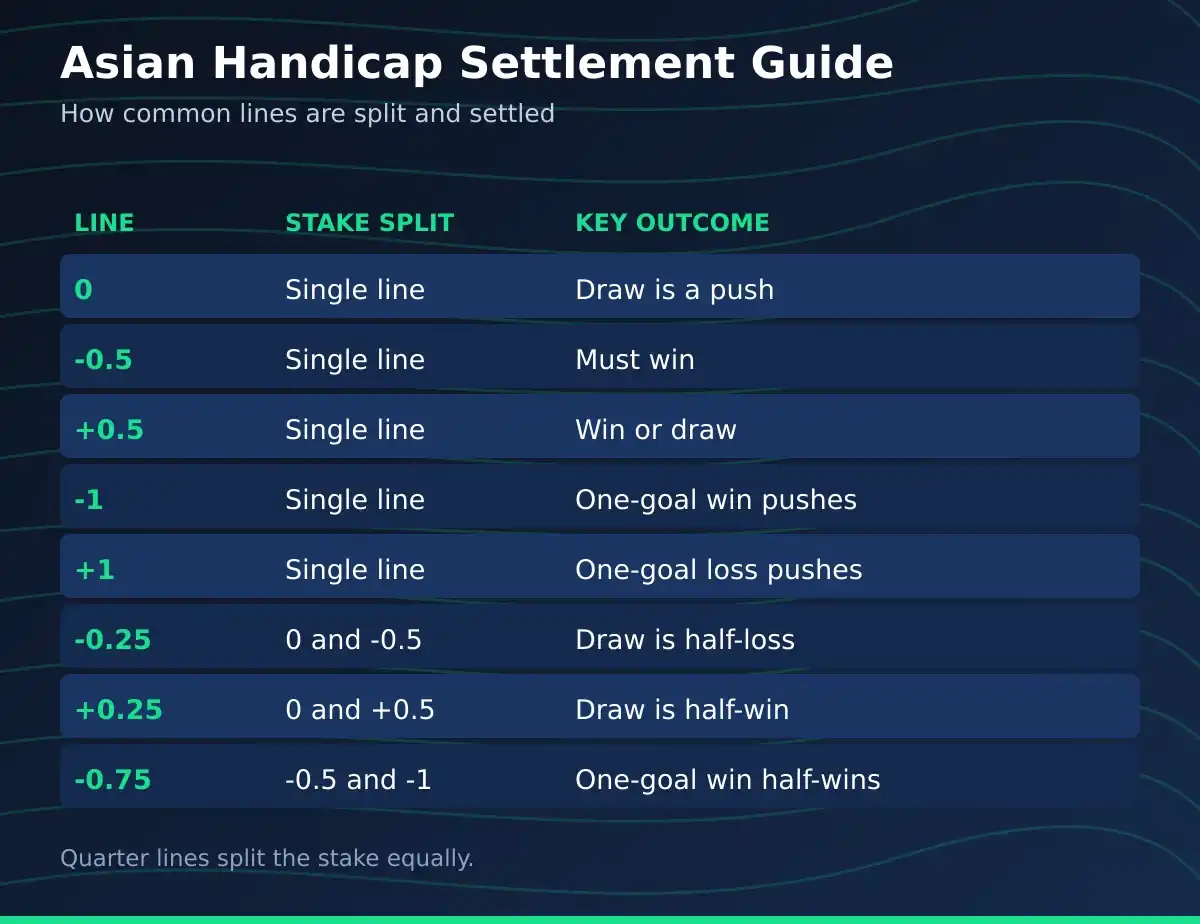
A quarter ball handicap is a line ending in .25 or .75, such as -0.25, +0.25, -0.75 or +0.75. These lines split your stake into two equal parts on two neighbouring lines.
For example, -0.25 is half on 0 and half on -0.5. If your team wins, both parts win. If it draws, the 0 part pushes and the -0.5 part loses, creating a half-loss. If it loses, both parts lose.
Another common example is -0.75, which is half on -0.5 and half on -1. If your team wins by one goal, the -0.5 part wins and the -1 part pushes, creating a half-win. If it wins by two or more, both parts win.
This is the key point in any asian handicap explained guide: quarter lines are not mysterious special rules. They are simply two half-stakes on two different handicaps.
Asian handicap examples and settlement calculations
The examples below use fictional teams, fictional scores and a 10-unit stake. They do not use a fixed price because prices vary by market. If a part of the bet wins, it is settled at the price you accepted. If a part pushes, that part of the stake is returned. If a part loses, that part of the stake is lost.
When reading asian handicap examples, focus first on the football margin. Ask how many goals your team won or lost by, then apply the line.
| Selection | Fictional score | Handicap result | Settlement on 10 units |
|---|---|---|---|
| Team A 0 | Team A 1-1 Team B | Push | 10 units returned |
| Team A -0.5 | Team A 1-1 Team B | Loss | 10 units lost |
| Team A +0.5 | Team A 1-1 Team B | Win | 10 units win at selected price |
| Team A -1 | Team A 1-0 Team B | Push | 10 units returned |
| Team A +1 | Team A 0-1 Team B | Push | 10 units returned |
| Team A -0.25 | Team A 1-1 Team B | Half-loss | 5 returned, 5 lost |
| Team A +0.25 | Team A 1-1 Team B | Half-win | 5 win, 5 returned |
| Team A -0.75 | Team A 1-0 Team B | Half-win | 5 win, 5 returned |
| Team A +0.75 | Team A 0-1 Team B | Half-loss | 5 returned, 5 lost |
How a push works
A push happens when the adjusted handicap score is level. Suppose you back Team A -1 with a 10-unit stake. Team A wins the real match 2-1. After the -1 handicap is applied, the adjusted result is 1-1. The bet is void on that line, so the 10-unit stake is returned.
The same principle applies to a positive whole line. If you back Team A +1 and Team A loses 2-1, the handicap makes the adjusted score 2-2. Again, the result is a push.
How a half-win works
A half-win occurs on a quarter line when one half of the stake wins and the other half pushes. Suppose you back Team A -0.75 with 10 units. That is the same as 5 units on Team A -0.5 and 5 units on Team A -1.
If Team A wins 1-0, the -0.5 part wins because Team A won the match. The -1 part pushes because the one-goal win is exactly cancelled by the handicap. So 5 units win at the selected price and 5 units are returned.
For a positive example, Team A +0.25 is half on 0 and half on +0.5. If the match is drawn, the 0 part pushes and the +0.5 part wins. That is also a half-win.
How a half-loss works
A half-loss is the mirror image. One half of the stake loses and the other half pushes. Suppose you back Team A -0.25 with 10 units. That is 5 units on Team A 0 and 5 units on Team A -0.5.
If the match is drawn, the 0 part pushes and the -0.5 part loses. The settlement is 5 units returned and 5 units lost.
For another example, Team A +0.75 is half on +0.5 and half on +1. If Team A loses by exactly one goal, the +0.5 part loses, but the +1 part pushes. That creates a half-loss rather than a full loss.
How to analyse an Asian handicap line
Good analysis starts with the line, not with the team name. A favourite at -0.5, -1 or -1.5 is being asked to do different things. An underdog at +0.5, +1 or +1.5 is being given different levels of protection.
First, translate the line into a football question. Team A -0.5 asks, “Will Team A win?” Team A -1 asks, “Can Team A win by two or more, with a one-goal win returning the stake?” Team A +1 asks, “Can Team A avoid losing by more than one goal?” This simple translation prevents many beginner mistakes.
Second, separate opinion from price. You might believe a team is stronger, but the handicap may already reflect that. In probability terms, every price implies a break-even chance before market margin. You do not need advanced maths to understand the principle: a stronger team is not automatically a better selection if the line demands a large winning margin.
Third, think about match state. A team that scores early may change its approach. A side protecting a lead may care more about control than another goal. A heavy favourite can still win the match but fail to cover a negative handicap. This is why Soccer Handicap Tips should consider style, motivation, schedule and likely game flow, not only the league table.
Fourth, compare related markets. If the match result market, totals market and handicap line seem to tell different stories, slow down and ask why. A low-scoring match expectation can make big negative handicaps harder to cover. A high-scoring expectation may increase the chance of bigger margins, but it can also increase volatility.
For wider pre-match context, many readers use football tips as one input rather than a final answer. This is also where Wintips.com can be useful for learning how previews frame team news, tactics and market lines. The same discipline helps if you compare Soccer Tips from different sources: look for reasoning, not just a selection.
Common risks and beginner mistakes
The first common mistake is treating Asian handicap as a safer version of normal betting. It is more flexible, but it still carries risk. A +1.5 line gives protection, yet it can still lose if the team is beaten by two or more. A -0.25 line reduces the cost of a draw compared with -0.5, but it does not remove risk.
The second mistake is misunderstanding quarter lines. A quarter handicap does not mean the team can score a quarter of a goal. It means the stake is split into two equal parts. If you remember that rule, half-wins and half-losses become much easier to calculate.
The third mistake is ignoring the exact handicap sign. Team A -1 and Team A +1 are opposite positions. The minus sign belongs to the team giving away goals on the betting line. The plus sign belongs to the team receiving a head start. Always check the sign before confirming how the bet would settle.
The fourth mistake is assuming that a push is profit. A push returns the stake on that part only. It is neither a win nor a loss. On quarter lines, one half can push while the other half wins or loses, which is why the final settlement may not feel obvious at first glance.
The fifth mistake is chasing losses after a bad result. Handicap Betting Tips can help explain a market, but they cannot remove uncertainty from football. Red cards, injuries during the match, tactical changes and finishing variance can all affect the final score. Any football predictions should be treated as analysis, not certainty.
The best beginner habit is to write the line out before the match. For example: “Team A -0.75 means half my stake is on -0.5 and half on -1.” Then list the key outcomes: win by two, win by one, draw, lose. This small step often prevents confusion when the final whistle arrives.
Asian handicap betting: final checks before reading tips
Before using asian handicap betting in your match research, make sure you can answer four questions. What is the handicap line? Is it whole, half or quarter? What real score margins make it win, push or lose? And what part of the stake is affected if the line is split?
Once those answers are clear, the market becomes much easier to read. A -0.5 line is a straight need-to-win position. A 0 line protects against the draw. A -0.25 line creates a half-loss on the draw. A -0.75 line creates a half-win on a one-goal victory. Positive lines work the same way in the opposite direction.
Use this guide as a settlement checklist, not as a promise of profit. The value of Asian handicap markets is precision: they let you match your view to a specific margin. The risk is also precision: if you misunderstand the line, you may be taking a very different position from the one you intended.
Frequently asked questions
What does Asian handicap mean in football?
Asian handicap means one team receives a virtual head start or disadvantage before settlement. You add the handicap to your selected team’s goals, then compare the adjusted score with the opponent’s score.
What is the difference between -0.5 and -1?
At -0.5, your team must win the match or the bet loses. At -1, your team must win by two or more for a full win, while a one-goal win is a push and returns the stake.
Why do quarter handicaps create half-wins and half-losses?
Quarter handicaps split the stake into two equal parts on neighbouring lines. If one part wins and the other pushes, it is a half-win. If one part loses and the other pushes, it is a half-loss.
Responsible gambling: Betting is for adults aged 18+ only. Set limits, keep it recreational, and never bet money you cannot afford to lose.