Football betting odds explained in plain English: learn decimal, fractional and American formats, implied probability, returns and bookmaker margin before comparing any market.
If you have ever looked at decimal, fractional or American prices and wondered what they really mean, this guide has football betting odds explained in plain English. Read through to learn how odds show total returns, implied probability and bookmaker margin, so you can compare markets, understand examples and read football predictions with more context.
Football betting odds explained: the basics
Football odds are a way of expressing two things at once: the potential payout on a selection and the market’s view of how likely that outcome is. A shorter price usually means the outcome is considered more likely. A bigger price usually means it is considered less likely, but with a higher possible return if it wins.
The same match can be shown in different odds formats depending on the region, app or website. Decimal odds are common in Europe and many international markets. Fractional odds are traditional in the UK and Ireland. American odds are widely used in the United States. The format changes the presentation, not the underlying idea.
Before going further, it helps to separate three terms:
- Stake: the amount placed on a selection.
- Profit: the amount won above the original stake.
- Total return: the stake plus the profit, assuming the selection wins and the bet is settled normally.
Official settlement rules can vary between operators and markets, especially around postponed matches, abandoned matches, void selections and each-way or special markets. In standard football win markets, if a bet is void, the usual principle is that the stake is returned rather than settled as a win or loss.
The three main football odds formats
The easiest way to learn odds is to see the same idea in each format. The examples below are hypothetical and used only to explain the calculation.
Decimal odds
Decimal odds show the total return for every unit staked. This is why they are often the simplest format for beginners. If decimal odds are 2.50, a winning £10 stake returns £25 in total. The profit is £15 because the £10 stake is included in the £25 return.
The formula is straightforward:
- Total return = stake × decimal odds
- Profit = stake × (decimal odds − 1)
For example, with £10 at 2.50:
- Total return = £10 × 2.50 = £25
- Profit = £10 × 1.50 = £15
That is decimal odds explained in their simplest form: the number already includes the stake in the return.
Fractional odds
Fractional odds show profit relative to stake. A price of 5/2 means you can make 5 units of profit for every 2 units staked. If you stake £10 at 5/2, the profit is £25 and the total return is £35.
The formula is:
- Profit = stake × numerator ÷ denominator
- Total return = stake + profit
Using £10 at 5/2:
- Profit = £10 × 5 ÷ 2 = £25
- Total return = £10 + £25 = £35
Fractional odds can look less direct at first because they focus on profit, not total return. Once you remember that the stake is added back after the profit calculation, the format becomes much easier to read.
American odds
American odds use plus and minus signs. A positive number shows how much profit a 100-unit stake would make. A negative number shows how much must be staked to make 100 units of profit.
For positive American odds, such as +150, a $100 stake would make $150 profit. A $10 stake would make $15 profit, for a $25 total return.
For negative American odds, such as -200, you would need to stake $200 to make $100 profit. A $10 stake at -200 would make $5 profit, for a $15 total return.
American odds are not better or worse than decimal or fractional odds. They simply express the same relationship in a different way.
How to calculate implied probability and returns
Implied probability converts odds into a percentage chance. It does not prove the true chance of an outcome. It only shows what probability is suggested by the price before adjusting for bookmaker margin.
For decimal odds, the calculation is:
- Implied probability = 1 ÷ decimal odds
At decimal odds of 2.50:
- 1 ÷ 2.50 = 0.40
- 0.40 = 40%
For fractional odds, the calculation is:
- Implied probability = denominator ÷ (numerator + denominator)
At 5/2:
- 2 ÷ (5 + 2) = 2 ÷ 7
- 2 ÷ 7 = 0.2857
- 0.2857 = 28.57%
For American odds, there are two formulas:
- Positive odds: 100 ÷ (American odds + 100)
- Negative odds: absolute American odds ÷ (absolute American odds + 100)
At +150:
- 100 ÷ (150 + 100) = 100 ÷ 250
- 100 ÷ 250 = 0.40
- 0.40 = 40%
At -200:
- 200 ÷ (200 + 100) = 200 ÷ 300
- 200 ÷ 300 = 0.6667
- 0.6667 = 66.67%
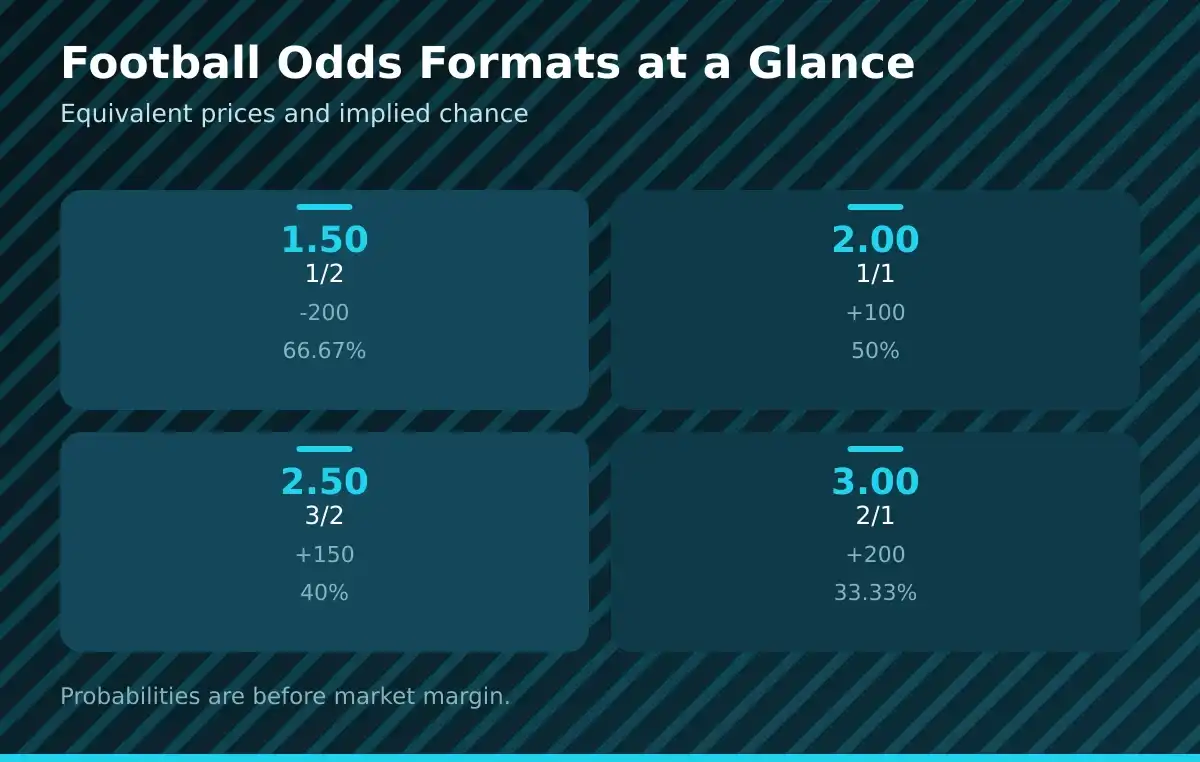
| Decimal | Fractional | American | Implied probability |
|---|---|---|---|
| 1.50 | 1/2 | -200 | 66.67% |
| 2.00 | 1/1 | +100 | 50% |
| 2.50 | 3/2 | +150 | 40% |
| 3.00 | 2/1 | +200 | 33.33% |
A football odds calculator can save time when converting formats, but it is still useful to understand the formulas. When you know the maths, you can quickly spot whether a price is short, fair, or bigger than you expected based on your own view of the match.
Bookmaker margin and why odds differ
In a fair market with no margin, the implied probabilities of all possible outcomes would add up to 100%. In real betting markets, they usually add up to more than 100%. The amount above 100% is commonly called the bookmaker margin, overround or vig.
Here is a simple hypothetical 1X2 football market:
| Outcome | Decimal odds | Implied probability |
|---|---|---|
| Home win | 1.80 | 55.56% |
| Draw | 3.60 | 27.78% |
| Away win | 4.80 | 20.83% |
| Total | - | 104.17% |
The total implied probability is 104.17%, not 100%. In this example, the margin is 4.17 percentage points. That does not mean the operator makes that exact amount on every match, because real betting liabilities and customer stakes vary. It simply shows that the market prices include an edge in the book.
Margins also explain why different operators may show different prices on the same outcome. One market may be more competitive, slower to move, or shaped by different trading opinions. The key lesson is not to read odds as a perfect forecast. Odds are a priced opinion with margin included.
This matters for football predictions because two analysts can agree that a team is more likely to win but disagree on whether the available price is worth attention. Good analysis is not only about picking the most likely outcome. It is also about comparing the chance you estimate with the probability implied by the odds.
Practical ways to use odds before reading tips
Odds become more useful when you connect them with match context. A low price may reflect squad strength, home advantage, market demand, tactical match-up or recent information. A high price may reflect uncertainty, a difficult away match, or simply a low-probability result.
When reading soccer betting tips, start by checking what the odds imply. If a selection is priced at 2.00, the implied probability is 50% before margin. If your own analysis does not support that level of confidence, the price may not be appealing even if the team looks stronger on paper.
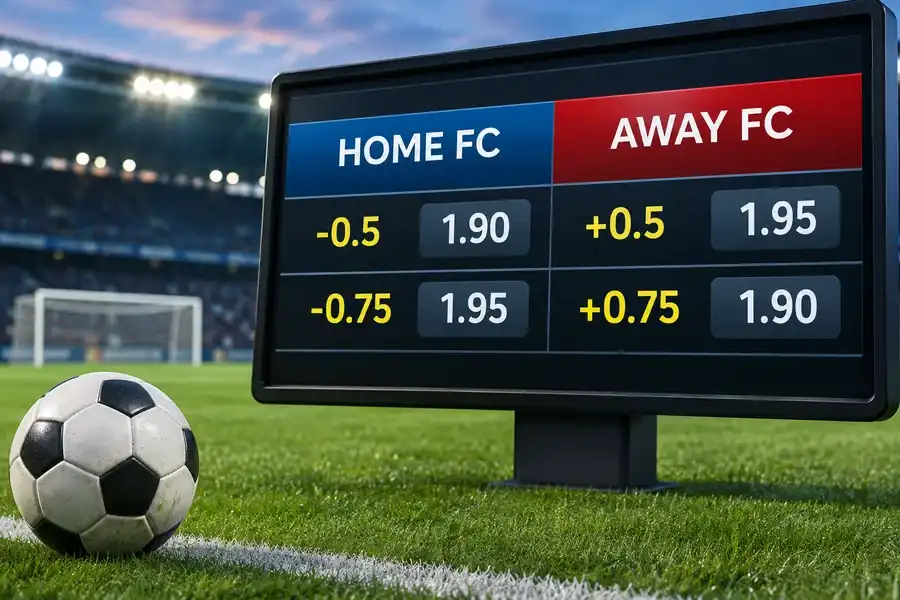
This approach also helps when comparing markets such as match winner, double chance, totals, both teams to score and handicap lines. Soccer Handicap Tips, Football Handicap Tips and Asian Handicap Tips often depend on understanding not only who might win, but also how the line changes the settlement. Handicap Betting Tips can look attractive, but the odds and rules must be read carefully before any conclusion.
Beginners often make the mistake of focusing only on possible profit. A bigger potential return does not automatically mean a better selection. It usually means the outcome is considered less likely. The more useful question is whether the odds are bigger or shorter than the chance you believe the outcome has.
Another common mistake is treating odds movement as proof. A price shortening can suggest market support, but it does not guarantee that new information is correct or that the outcome will happen. A price drifting can suggest weaker demand, but it does not automatically make the selection poor.
As you compare markets, remember that football tips can explain the reasoning behind a selection, but the final responsibility for understanding the price remains with the reader. That is why Soccer Tips should be treated as analysis, not instruction.
Concise conclusion
Football betting odds explained in a clear way can make every market easier to read. This guide has shown how decimal odds, fractional odds and American odds all describe the same basic idea: the relationship between stake, profit, total return and the market’s view of an outcome. Decimal odds show total return directly, fractional odds focus on profit relative to stake, and American odds use plus and minus signs around a 100-unit benchmark.
The article also covered implied probability, which turns odds into a percentage, and bookmaker margin, which helps explain why a market’s total probability is usually above 100%. These ideas are useful before reading previews, football predictions or handicap markets, because a selection is not only about which team looks more likely to win. It is also about whether the price matches the chance you believe that outcome has.
In short, the aim is not to predict every match correctly or treat odds as a perfect forecast. The aim is to understand what the numbers mean, compare them with your own view of the match, and read soccer betting tips with more context. Thanks for reading, and see you in the next guide.
Frequently asked questions
What is the easiest odds format for beginners?
Decimal odds are usually the easiest because they show total return directly. If the odds are 2.50 and the stake is £10, the total return is £25.
Are implied probability and real probability the same?
No. Implied probability is calculated from the odds. Real probability is your estimate of how likely the outcome truly is, based on analysis and available information.
What does bookmaker margin mean?
Bookmaker margin is the amount by which the total implied probability of a market exceeds 100%. It is built into the prices and varies by market.
To sum up, football betting odds explained is about understanding what the prices are really showing, how implied probability works, and why bookmaker margin matters before you compare any market. Use that knowledge to read odds more clearly, judge football predictions with a cooler head, and avoid treating any pick as guaranteed.
Thanks for reading, and good luck with your research. Gambling is for adults aged 18+ only. Set limits, keep it recreational, and never bet money you cannot afford to lose.